
Despina Tunberg curatorial review
Patrick Joosten: Architect of the Unstable - Painting the Mind in Motion
A Curatorial Review by Despina Tunberg - Curator and Author
A recent curatorial review by Despina Tunberg examines the artistic practice of Patrick Joosten, focusing on his exploration of instability, emotional tension, material transformation and the relationship between structure and dissolution.
Every serious abstract painter is, in the end, trying to solve an impossible problem, and Patrick Joosten has had the clarity to state his outright. ``How,`` he asks, ``can one make visible what cannot be stabilized: emotion, perception, or mental flow?`` It is a deceptively simple question with no final answer, and it is the engine of his entire practice. The French painter has built a body of work around the attempt to give form to precisely those things that refuse to hold still: the movement of feeling, the flicker of perception, the currents of thought that pass through a mind faster than any image can fix them. He calls himself an ``architect of emotional abstract landscapes,`` and the phrase is exact. He is not painting the visible world; he is building structures for the invisible one.
That Joosten arrived at so considered a project without academic training is itself telling. He is self-taught, having, in his own account, ``developed independently from academic frameworks,`` and the independence shows not as roughness but as freedom. Untethered from a school’s orthodoxies, he has been able to construct a personal language from first principles, testing what paint can and cannot do without the inherited assumptions that formal training so often installs. The result is a practice that is, in his words, ``intuitive yet disciplined``: the intuition of an artist who trusts his own hand, married to the discipline of one who has had to earn every technical decision for himself.
The method he has arrived at is best described as a controlled dialectic. Joosten treats the canvas as ``a field of transformation where gesture, material, and structure operate in continuous dialogue,`` and the three movements of his process construction, disruption, and erasure enact a kind of visible thinking. He builds a structure, then breaks it, then partly effaces it, and the finished painting holds all three moments at once: the thing made, the thing disrupted, and the ghost of the thing removed. This is what he means by ``controlled unpredictability``: a studio practice deliberately open to accident, yet governed throughout by a searching intelligence. The tension he prizes above all is the one ``between emotional intensity and formal restraint,`` between the heat of feeling and the cool of composition, and it is the sustained holding of that tension that gives his best work its charge.
Technically, this plays out through layering, transparency, and what he calls ``gestural rupture.`` Working primarily in acrylic, Joosten builds translucent strata that let earlier states show through later ones, so that the surface carries its own history: a mark is never simply covered but remains dimly present beneath what follows.
Across these layered surfaces, he deploys fragmentation, chromatic tension, and spatial modulation, the sense of a space that expands and contracts as the eye moves through it. Color, for Joosten, is never decorative. He uses it structurally, as ``an emotional vector, organizing internal rhythms that guide the gaze,`` each hue a force with a direction, drawing the viewer’s attention along the internal currents of the painting. To look at a Joosten canvas is to be led, not merely shown.
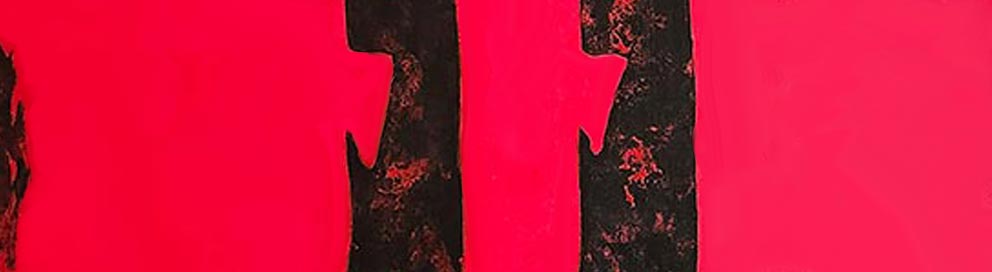
The recent paintings give this philosophy concrete form. Crimson Silence (acrylic, 140 by 90 cm, 2026) sets its charged red against the paradox of its title: a color of maximum intensity held, somehow, in stillness, the very equilibrium of intensity and restraint that Joosten seeks. Rainbow (acrylic, 140 by 90 cm, 2024), which earned a Masterpiece Award, takes the fullest possible chromatic range as its subject, the spectrum itself organized into emotional rhythm. These works belong to a practice Joosten has sorted into distinct but related bodies: the Abstract Works that form his core, the Motion Fields whose very name announces his preoccupation with the unstable and the moving, and the Figurative Abstractions in which the human presence hovers at the threshold of dissolution. Across all three, the constant is the attempt to render ``invisible territories of human experience``: memory, sensation, psychic energy in a form the eye can enter.
What distinguishes Joosten from the many painters working in a gestural abstract mode is the rigor of his framing. His is not expressionism, not the simple outpouring of feeling onto canvas; it is a considered inquiry into the ``tension between structure and dissolution`` that governs both the mind and the picture. He is as interested in what falls apart as in what holds together, and his paintings stage that drama: form coalescing and coming undone within the same visual field. It is an art, finally, about the conditions of experience itself: how anything so fluid as consciousness ever takes, however briefly, a stable shape.
The contemporary art world has recognized the seriousness of the project with notable speed. In 2023 Joosten received the sixth International Prize Leonardo da Vinci and was named among Art Tour International’s Top 60 Masters; in 2024 he was honored as a Global Art Virtuoso and given a Future of Art Award by Contemporary Art Curator, which has cast him, aptly, as an ``artist of the future``; and in February 2025 the Circle Foundation for the Arts named him Artist of the Year with its Masterful Minds Award. He has also been a finalist for Artist of the Year through Artavita and TERAVARNA. For a self-taught painter working outside the academy, it is a striking concentration of international recognition in a very short span: evidence that his attempt to picture the unpicturable has struck a real chord.
That is the coherence of a practice that could, in lesser hands, dissolve into mere abstraction.
Patrick Joosten has set himself one of the hardest problems a painter can take up: to make the unstable visible, and he pursues it with a rare combination of intuition and rigor, feeling and restraint, construction and erasure. His canvases do not resolve the problem, because it cannot be resolved; they do something better, which is to make the struggle itself beautiful.
For the collector, Patrick Joosten represents an increasingly compelling proposition: a self- taught French abstractionist with a fully articulated philosophy, a distinctive and technically sophisticated surface, and a rapidly rising international profile. The work rewards on both the immediate and the sustained level the layered, luminous surfaces and structurally deployed colour are arresting at first sight, while the depth of the underlying inquiry rewards the long, repeated looking that serious abstraction demands. Major recent canvases such as Crimson Silence and the award-winning Rainbow, at a substantial 140 by 90 centimeters, offer statement pieces for a significant wall, while the distinct bodies of work the core Abstract Works, the Motion Fields, and the Figurative Abstractions give the collector clear avenues to follow. With a concentrated run of international honors since 2023 the Leonardo da Vinci prize, the Circle Foundation’s Artist of the Year, Art Tour International’s Top 60 Masters and prices still reflecting an artist in ascent, the practice of Patrick Joosten will reward the collector who values conceptual depth as much as visual power, and who wishes to acquire a mature abstract vision while its maker is still, in the art world’s own phrase, an artist of the future.
Despina Tunberg
Curator and Author
Despina Turnberg
Despina Turnberg is a curator, author, and art writer whose work focuses on contemporary art and the development of emerging and established artistic practices. Through her curatorial and critical writing, she explores the ideas, processes, and visual languages that shape contemporary artists and their work. Her curatorial review of Patrick Joosten examines his approach to abstraction, focusing on the relationship between emotional intensity, structure, material transformation, and controlled unpredictability.
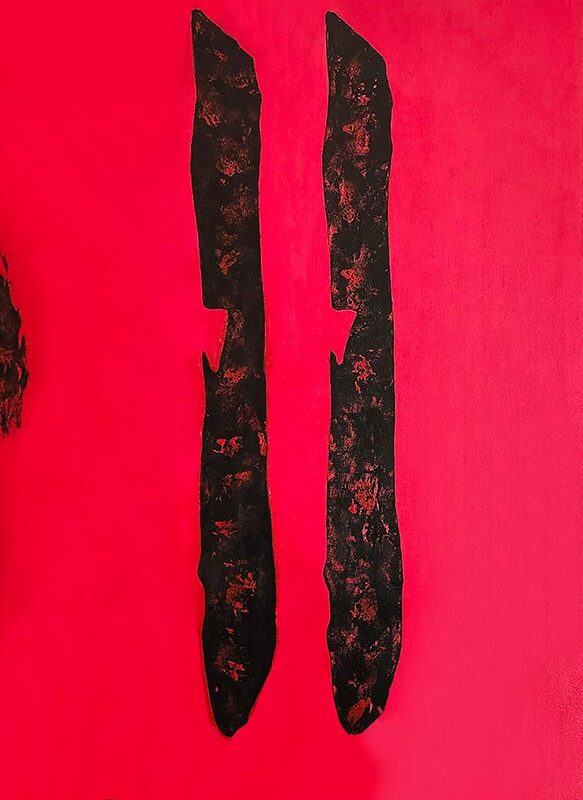
Crimson Silence
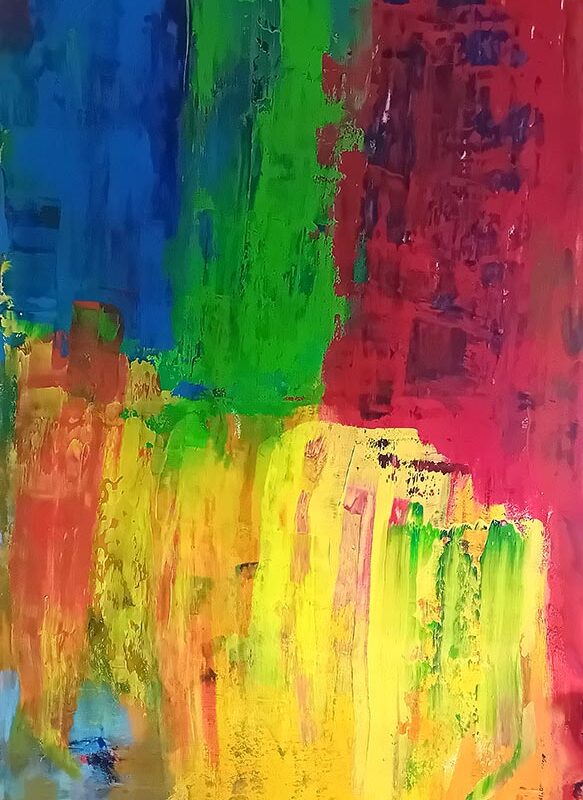
Rainbow